Beauty
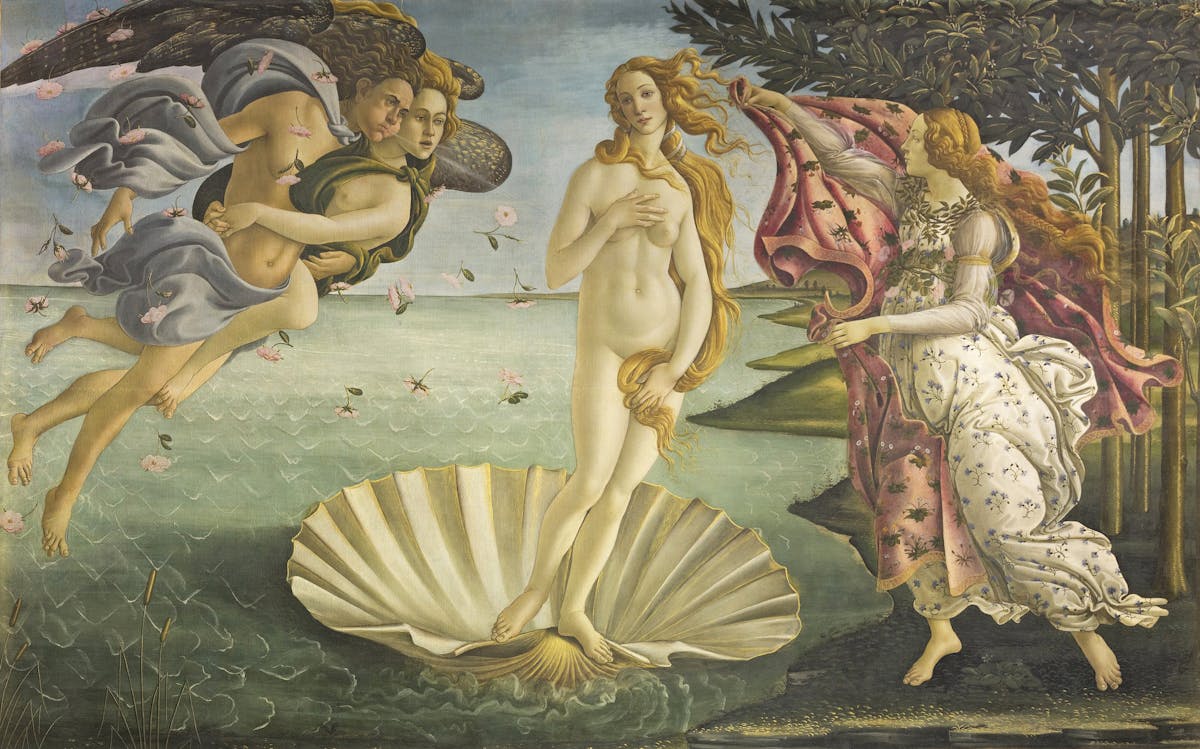 |
| Sandro Botticelli, Birth of Venus, 1485. Tempura on Canvas, The Uffizi. |
In the art world, beauty is a common theme. Many people have entirely unique ideas of what beauty is and how it can be represented. Hickey believes beauty is subjective, which most can agree. Where Amelia and Hickey differentiate is with the criteria of beauty. Amelia explains how Hickey feels a sense of entitlement when determining what beauty is. Beauty is subjective to the viewer, right? While beauty is essentially subjective, it does not give people the right to claim what beauty is and what it means. Amelia states in her writing, "I do not believe the aesthetic approach to visual culture, which inevitably cleaves to the connoisseurial tradition and perpetuates its authoritarian effects, to be a productive one at this point in our cultural history." (Jones, 2) Amelia does not find the souly "visual" approach to beauty to be effective. By having one man decide what beauty is and that becoming the standard for everyone tarnishes the overall idea of beauty being subjective. Amelia believes that people have the right and freedom to decide what beauty means to them, and she agrees that Hickey's ideology revokes people of that right.
I personally feel Amelia is right. When Hickey explains what beauty is, he seems almost bigoted in the sense that he is an “almighty knowing being” that knows what beauty is. In the beginning of the writing from Amelia, there is a quote from John Ruskin. He states, “Every man knows where and how beauty gives him pleasure…” (Ruskin) I find this quote to be entirely narcissistic. Yes, beauty is subjective and is different for everyone. However, to blatantly say that all men can agree what beauty is and how it pleasures them is disappointing. That is a prime example of the bigotry Amelia argues against.
To apply these ideas to a common example is with the Birth of Venus. With many paintings in the early 1400s to the late 1600s, you see many women portrayed as who they really are. As you can see Venus, the woman in the painting, is entirely natural. She has natural curves, untamed flowing hair, pale skin, and natural features. Venus is the most beautiful women. The other figures in the painting surrounding her are representing the awe of her beauty. At the time, this is what beauty was, and it was realistic.
Over time, especially growing up as a teenager with social media, I find Ruskin’s comment to be relevant. I will add another current example of where the definition of beauty and the subjectivity of beauty becomes faltered. Let’s use the Kardashians. I remember in my middle school days, Kylie Jenner and Kim Kardashian were all the hot gossip. The Kylie Jenner lip challenge and the fillers and implants were everywhere. The Kardashians were women who had visibly altered their natural self and made it public. Bigger boobs, bigger butts, and bigger lips, tiny waists, revealing clothing, etc. All these things made me, and an entire world of young teens extremely self-conscious. Men ogled after the Kardashians, which made me feel ugly. I did not have big lips, a big butt, or big boobs. For a long time, I deemed myself unattractive. Some men somewhere found the Kardashians to be attractive. Their beauty gave these men pleasure. In relation to Ruskin and Hickey’s beliefs, you could say these men felt self-righteous to say that the Kardashians were the face of beauty.
It took me a long time to realize, one man’s idea of beauty is not what the true meaning of beauty is. Amelia implies that the meaning of beauty is something people have the right to decide. I know now that what I find beautiful, is not what others would. I have the right to decide what is beautiful. If I feel curly natural hair, natural lips, and a normal body is attractive, that is my freedom. With the Birth of Venus, I appreciate the unaltered painting of a woman. Botticelli did not make her waist smaller, and he did not make her boobs enormous, and he did not make her facial features bigger. He painted a woman exactly how she was and described her as the goddess of beauty. I truly think society has been brain washed into thinking there is one definition of beauty. I hope for all the young girls who struggle with feeling beautiful, due to societal standards, that they can realize they don’t owe anyone anything.
Amelia Jones, Every Man Knows Where and How Beauty Gives Him Pleasure: Beauty Discourse and the Logic of Aesthetics (PhD diss., Oxford University Press, 2002), 216.
https://www.uffizi.it/en/artworks/birth-of-venus#text


Well said, Annabelle. I agree, Hickey does seem like a bigoted man who believes that only he knows what beauty truly is. I also got the same vibe from Ruskin. His quote, "Every man knows where and how beauty gives him pleasure" just sounds so... scuzzy. Growing up, I have also compared myself to people like the Kardashians. According to the majority of society, they are the pinnacle of beauty, but those are very unrealistic standards, and we shouldn't compare ourselves to them. I love that you mention how you realized we all have the right to decide what beauty is.
ReplyDelete